Showing posts with label Notice and Note. Show all posts

Three Things I Loved About My Week: Memory Moments, Decimals, and Community Gardens

Hi friends!  I'm back to share Three Things I Loved About My Week with you. I can't believe I just sent home progress reports for the last quarter of the school year!  I am really looking forward to slowing down when summer begins.  I love my class, and I loved the challenge of learning a new grade level.  But I'm ready to make more choices about my time!

#1: Memory Moment
This week we used The Day the Crayons Quit as our Mentor Text.  I love how cute this text is!  I know this book has been out for awhile, but I didn't really have a reason to use it as a middle school teacher.  When I picked it up at the library,  I loved that my mind went to the Memory Moment signpost right away! It was perfect the way the author gives the crayons personalities, and they share the memories of how Duncan uses the crayons.
(Amazon Affiliate Link)
I used the text for mentor sentence work this week, so it incorporates a ton within one book.  What made me happy was that the first day we looked at the text, our Invitation to Notice day, several of my students noticed that this book contained a Memory Moment!  <HOORAY>!  Imagine me doing the happy dance!

I just recently taught this signpost and we dug deep with our novel Lunch Money.  It was nice to see the information transfer to other stories as well!
Right now we are working on Color Poems.  Students chose their favorite colors, and we are in the process of using our senses to describe them.  I can't wait to see how they turn out!


#2 Decimal Fraction Review
We took our End of Module assessment this week for our Decimal Fraction Relationships unit.  My kids really worked hard. We started our unit looking at how decimals and fractions are similar. Did you grab this FREEBIE that I created as a quick formative? It was quick and easy and my class started the unit with a Win-Win.  As we progressed, we learned how to translate decimals into fractions to add them.  We also plotted numbers on the number line, and learned how to change decimals and fractions between each other in computation and word problems.  One of the things I really love is how our modules build on one another.  They always give students problems that contain multiple steps that build.  I use these problems a lot for team building activities.  Instead of having just one problem that everyone completes, I create multiple problems that are similar.  Students work together in teams to answer each question.  It creates a feeling of anticipation and cooperation within the group.  Plus it makes review a lot more interesting than "Another Math Worksheet" <Insert fourth graders rolling their eyes here>

#3 Spring Gardens
The third thing about my week that I LOVED, was the spring gardens that are popping up around our school.  This is a project that our third graders participate in, but I have loved watching it grow! Every third grader participates in the program.  Once a week, someone from the community food co-op comes out and talks to students about healthy eating, gardens, vegetables, etc.  Each student has a gallon bucket where they have planted different veggies, and the students learn to tend the gardens.  They grow several types of lettuces, tomatoes, peppers, cucumbers, squash and a few herbs.  When the items are ready to harvest, students help and then participate in a healthy meal together.  Of course there are PLENTY of leftovers, so students go home with two bags of fresh veggies each to share with their families.  I love the community support this program has!
Check out these amazing pictures!


Thanks for stopping by and letting me share a few things I've loved about this week.  I'd love to hear about something that was amazing for you!

Happy Weekend!

0

Notice and Note: Memory Moments

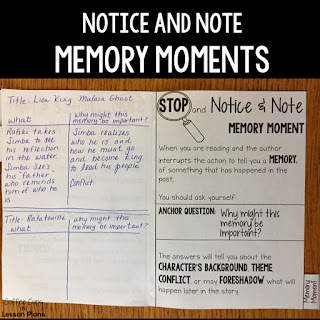
This week my class tackled the Notice and Note Signpost for Memory Moments.  When a reader is tracking her comprehension and she comes across a situation where a character's thoughts are interrupted by a memory or flashback that comes to the character, they are having a Memory Moment.


Memory Moments help readers understand  the plot, theme, and relationship between the character and the plot. They give us insight into the character's motivation behind some of their thoughts, words and actions.  When we encounter a Memory Moment in our books, I teach my students to stop and ask WHY might this memory be important?  The answer will tell us about a conflict, or development  that may be upcoming in the plot of the story.  The conflict may involve just the character, or may be alluding to something that will be forthcoming in the story.

I love when author's are really good at their craft... I mean, isn't that WHY we want to read their books?  Gary Paulsen starts Hatchet right out the gate with a Memory Moment within the first 3 pages of text.  Brian is sitting in the plane and he says "The thinking started."

(Amazon Affiliate Link)
My fourth graders are currently reading Lunch Money by Andrew Clements.  In chapters 5 and 6, Greg Kenton, the main character, shares two memory moments when he flashes back to the first time he meets his arch nemesis Maura.  As readers, we learn about why there is a conflict between these two characters.  I use these chapters in the book to talk to my students about internal and external conflict, and what that teaches use about a character as he/she is developing.  In this particular book, Clements shows Greg remembering something that troubles him, his competition with Maura.  This helps us to see the back story behind why Greg dislikes Maura so much.  It also helps us to make inferences about the plot of the story.  This really helps give my students a deeper purpose for reading.  They look at the novel more closely, because they are reading to prove if their inference has foundation.

(Amazon Affiliate Link)
 
When I first introduce the Memory Momentnt Signpost, I show my students an anchor chart, and we use our tabbed Notice and Note booklets.  We write examples of key words or clues we may encounter that will help us  recognize the signpost.  I also show them this video.  It gives them another overview of the signpost.

Then we use this video to practice the signpost with visual media.  It is easy for them to recognize.

I also like this video from Rataouille


If you have older students they will recognize this quick 20 second scene between Katniss and Peeta from the Hunger Games which gives great insight into the connection between the characters.


Before having my students find and discuss the Memory Moments in Lunch Money, I also remind them of previous picture books we have read that contain Memory Moments.  These include:
Saturdays and Teacakes
(Amazon Affiliate Link)
Wilfred Gordon McDonald Partridge by Mem Fox
(Amazon Affiliate Link)

A Chair for My Mother
(Amazon Affiliate Link)


Another book that I just recently found and am adding to my collection is The Day the Crayons Quit. 
(Amazon Affiliate Link)
I know this isn't a new book, I had just not thought about using it with Memory Moments until I pulled it out for our Mentor Sentences.  I LOVE when I have an AHA moment too! 

Do you have other books that you use to teach the Notice and Note Signpost for Memory Moment? I would love to hear about any new books that you have found that help students!


0

Notice and Note: Tough Questions

The third signpost in the Notice and Note Signpost for Fiction is Tough Questions.  When a reader is tracking her comprehension and she comes across a situation where a character is reflecting on a big moment, they are asking themselves a Tough Question.  As easy as this signpost sounds, it was by far the most difficult one for my students to look at.  Every time a character asked a question, they wanted to claim it was a tough question.  We needed a lot of examples and work to get on the right track with this signpost.  But, once we got moving, it really helped our comprehension grow.

Tough Questions allow readers to dig deeper into the meaning of text.  When we look for Tough Question signposts we need to think about character because Tough Questions help students learn about internal conflict.  This is a great time to teach types of conflict as well!! Usually I teach Man vs. Man, Man vs. Nature, Man vs. The World and Man vs. Self.  The Tough Questions signpost is taught after Man vs. Self.

In the Signpost book, Beers and Probst use A Long Walk to Water by Linda Sue Park. Have you read this novel?  AMAZING.. truly an inspirational story.  It should definitely be in your library.
(Link to Amazon)
I've also found several other resources that I used to help my students.  It was helpful for us to use our Notice and Note Signpost Tabbed Booklets to keep track of our comprehension.

Here are a few resources I used to introduce and practice Tough Questions:
Cooler Self - A Short Animation by Ozan Basaldi from Ozan Basaldi on Vimeo.

We also used a clip from Mulan.  Usually I show them Prepping for the Matchmaker, and we talk about whether this is the best choice for Mulan.  Then we watch the Reflection sequence.

Here is a student example of the page in our Tabbed Booklets.  

I've also used these books to help students:
Have you read The Yellow Star?
(Link to Amazon)

I love to use this book because it fits in with our Social Studies curriculum and World War II. Though this story is a legend, it has a remarkable message, and does a great job getting students to think about the Tough Question.  The king of Denmark is faced with a difficult decision when his country is about to be occupied, and Jews are forced to wear yellow stars on their clothing.  He must chose what is right for all people.  

Fly Away Home by Eve Bunting
(Link to Amazon)

Eve Bunting, deep on so many different levels.  her books are amazing for students because of her messages.  You have the ability to think about conflict and theme with both fourth graders and middle school age students with this type of book.  Bunting's books always have a twist and can really get a reader to think about the messages people send.

Bully by Patricia Polacco

(Link to Amazon)

Again, Polacco is an amazing author on so many levels.  I love this story because for Upper Elementary students the idea of cliques is all too much their every day reality.  Even in grades as low as third and fourth we start to see girls form cliques and shut others out.  Add in the social media of the 5th-8th grade set, and the Tough Questions asked in this book are an amazing way to have a conversation about more that our reading comprehension!

Do you have any favorites for Tough Questions?  I'd love to add your suggestions to my book list! 

1

Notice and Note: Aha Moments

My students are LOVING learning the signposts from Beers and Probst's Notice and Note book.  I can tell that they are really starting to tune into monitoring their comprehension, and are definitely leaving tracks in their learning.

Today I wanted to share with you a few resources I used when teaching the AHA MOMENT signpost.  I created a tabbed booklet for my Smarties to keep track of their learning.  We write an anchor chart on the right side of the booklet, and then create a t-chart on the left with a few examples from movie shorts and book excerpts.

The AHA moment is when the character realizes or finally understands something he has not known. It is a signpost to help readers recognize conflict and theme.  If the character has an AHA moment where they figure out a problem, then usually you can identify something about the conflict of the story.  When the AHA moment is about a life lesson you have probably learned a theme.  My students grasped this concept fairly quickly, although it is important for them to recognize that the AHA moment for the reader may be different from that of the character, and being aware of this is leaving tracks in their learning.

One powerful short that I used was a video from Jacob Frey called The Present.  You can find it on vimeo.  Watch how powerful it is to teach the signpost.

Another AMAZING video is called Snack Attack

Beers and Probst use excerpts from Jerry Spinelli's Crash to help reinforce the concept.  I have really enjoyed introducing each signpost with a short film or two, and then using a novel to see the words in action.  It has really helped my students understand each concept, and I have seen them quickly pick up on each signpost in their own independent reading as well.

Here are a few other picture books that you can use to teach AHA moments.

Have you read One Green Apple by Eve Bunting?  I LOVE her books!  There are so many amazing things you can do with them!  Even for upper grade students her picture books carry messages with strong themes.  One Green Apple is about a Muslim girl named Farah who has just moved to her new school and is on a field trip to an apple orchard.  She feels lonely and isolated, but soon comes to realize she has more in common with her classmates than she originally believed.  It is such a powerful story for students who have ESL in their classrooms!
(Link to Amazon)
I also love books by Chris Van Allsburg.  One of my favorites is The Stranger.  I love to read this book in the fall, and using it for AHA moments is a great experience because the Stranger never talks in the book.  You have to recognize his AHA moment by his facial expressions.  I also love it because your students don't recognize the AHA moment before the character, but once they realize it they can find evidence in the text that supports it.  These are real reading moments, and students are very eager to leave tracks in their learning with this book!
Link to Amazon
If you want to learn more about how I am teaching the Signposts, you can check out this post on Contrasts and Contradictions {HERE}.  
Keep reading friends!

4
Back to Top